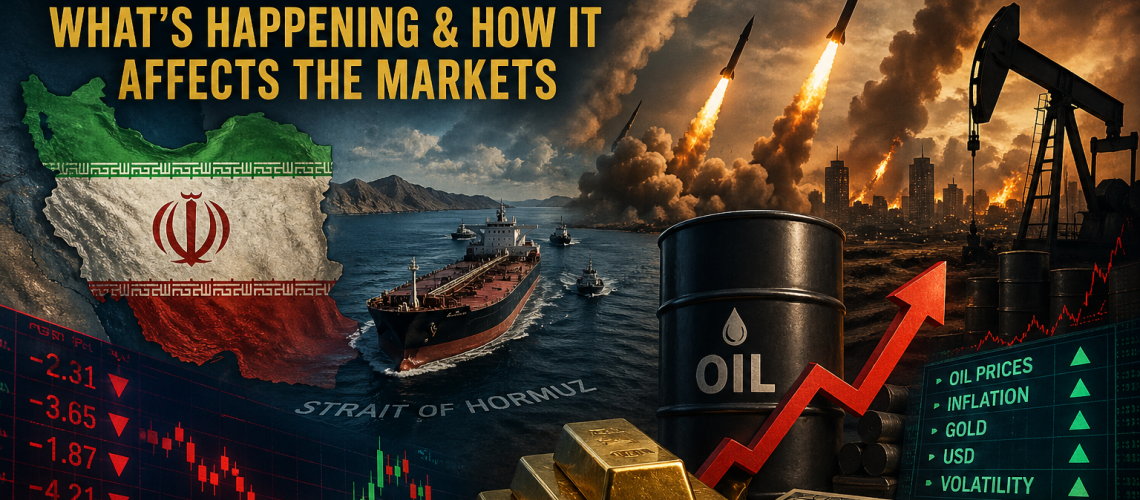
The situation involving Iran and regional powers continues to escalate, with ongoing military activity and disruptions around key strategic zones in the Middle East.
One of the most critical pressure points is the Strait of Hormuz, a vital passage for global oil shipping. Any disruption here immediately impacts global energy flow and market stability.
Recent developments show:
- 🚢 Repeated tensions around oil shipping routes
- 💥 Continued strikes and counter strikes in the region
- 🛢️ Supply disruptions affecting major oil exporters
- ⚠️ Heightened geopolitical uncertainty with no stable resolution yet
The broader conflict is no longer just regional. It is directly influencing global economic conditions through energy and trade channels.
🛢️ Oil market shock
Energy markets are the first and strongest reaction point.
- Oil prices surged sharply, with Brent moving above $100+ levels in periods of escalation
- Supply constraints are tightening global availability
- Refining and transport costs have increased worldwide
The International Energy Agency has already described the situation as one of the most severe supply shocks in modern oil markets due to reduced flows from the Gulf region .
📉 How markets are reacting
Financial markets are moving based on fear, inflation expectations, and energy costs:
📊 Stocks
- Global stock markets experience volatility and short term selloffs during escalation spikes
- Energy stocks tend to outperform due to higher oil prices
- Growth stocks often come under pressure because of higher inflation expectations
💵 Dollar & safe havens
- The US dollar strengthens during risk-off periods
- Gold demand rises as investors seek safety
- Bond yields fluctuate as inflation expectations shift
📈 Inflation & interest rates impact
This conflict is not only about geopolitics, it is directly changing macroeconomic expectations:
- ⬆️ Higher oil prices push inflation upward
- 🏦 Central banks may delay rate cuts or keep rates higher for longer
- 📉 Economic growth forecasts are being downgraded in some regions due to energy costs
Markets are now pricing in a more “stagflation-like” environment in certain scenarios, where inflation stays high while growth weakens .
⚠️ Key risks investors are watching
- 🛢️ Further disruption in global oil supply routes
- 🚢 Escalation affecting shipping insurance and logistics
- 💣 Expansion of conflict into wider regional instability
- 💸 Sustained inflation pressure impacting consumer spending
🧠 Bottom line
This conflict is acting as a global market shock through energy prices.
In simple terms:
- Higher geopolitical tension → higher oil prices
- Higher oil prices → higher inflation
- Higher inflation → more volatile markets and tighter monetary policy
Markets are currently moving based on headlines, energy flows, and risk sentiment rather than traditional fundamentals.